Saskatchewan Farmland: Peaking, Pausing, or Pulling Back?
Author
Tim Hammond
Date Published
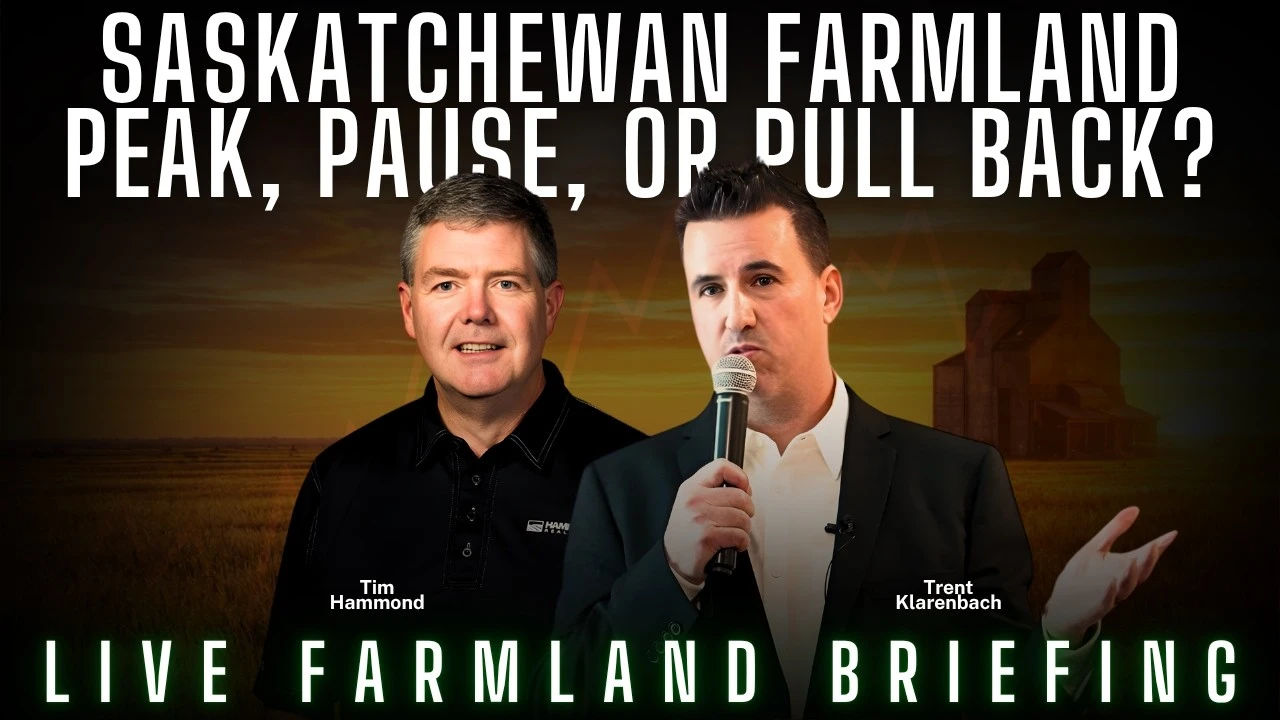
Here's what 140 producers, investors, and landowners actually think — and what I'm seeing on the ground. Last week, I joined Dan Aberhart of Growing the Future Productions and Trent Klarenbach on a live panel to tackle the question everyone in Saskatchewan agriculture is quietly asking right now: where is farmland headed? One hundred and forty people showed up. The questions were sharp, the chat was buzzing, and the poll results confirmed exactly what I've been watching unfold in the market every single day.
Here's what we talked about — and what it means for you, whether you're buying, holding, or starting to wonder if now is the time to sell.
The Poll That Said It All
Before we got into the analysis, Dan ran a quick poll. The question: Where do you think farmland values are headed?
The results:
- 22% — Continued strength
- 43% — A plateau
- 35% — A possible fallback
That's not the kind of split you saw three years ago, when almost everyone in the room would have said "up." The market has shifted, and this is the proof. People aren't panicking, but they're paying attention in a way they weren't before.
A second poll asked attendees what they were actually observing in their local market. Thirty percent said land is still very competitive with multiple bidders. Fifty-two percent said the market feels steady but not as aggressive. Twelve percent are starting to see softening in prices.
That's a 64% majority telling you the energy has changed. Not collapsed — changed.
This doesn't surprise me. It's exactly what I'm seeing on the ground.
A Split Market — And Why That Matters
I've been selling Saskatchewan farmland for over 35 years. I've never described myself as just a real estate professional — I'm an expert in human behaviour as it relates to farmland. The data matters, but what drives prices up and drives them down is emotion.
Right now, I'd characterize what we're seeing as a split market.
Good land in a good area? Still moving. Still attracting demand. In some cases, still setting records. Average land in an average area? It's struggling. Going sideways. In some cases, quietly coming down.
When someone asks me "is land going up or down?" — the honest answer is yes. It depends entirely on where you are and what you've got.
But here's what I'm watching more carefully than the sale price: bid depth. Two or three years ago, a tender on a good piece of land would attract ten offers. The top three or four bids would be clustered tight. That's a healthy market — it tells you there's real, competitive demand. Today, we're still getting a high top bid — sometimes a record — but we're getting two or three offers, and the spread between the first and second place has widened to five, ten, even fifteen percent.
As I told the group: land is only worth as much as what the second-highest bid is. If you had to turn around and sell tomorrow, what would you actually get? That's the number that matters.
What a Hundred Years of Data Is Telling Us
Trent Klarenbach — who produced the landmark technical analysis of Saskatchewan farmland values going back over a century — shared something worth sitting with. If you haven't seen the original research, we covered it in depth here, and the full conversation on YouTube has drawn over 52,000 views for good reason. The charts show that farmland, like every other market, moves in cycles driven by human emotion. We have been in elevated, overbought territory for over a decade. Historically, when those conditions have reversed, the drops have been significant: 22%, 54%, even 60% over multi-year periods.
Trent isn't calling a crash. He's a trend follower, and the trend hasn't broken yet. But the signals are worth knowing about.
The poll we ran on technical analysis was revealing: 64% of attendees said it's "somewhat useful but not definitive." That's a sophisticated answer. It's also the right one. No indicator tells you exactly what happens next. What the data gives you is a better-informed set of probabilities — and in this market, that edge matters
Rental Rates, Retired Farmers, and What's Coming
One more poll. This one on rental rates:
- 43% — Rental rates are increasing
- 40% — Holding steady
- 11% — Starting to soften
From where I sit, managing roughly 80,000 acres for sophisticated investors, we'll do well this year if we simply maintain what we negotiated last year. That's the first time I can say that. Some leases are going up. Some are coming down. On balance, it's flat — and that's new.
Here's what I think is worth watching: the retired farmer. Over the last 15 years, when people retired from farming, they held their land. The appreciation was too good to walk away from, and the rental income covered costs. But if land values stagnate or start to decline, a 1–2% cash return starts to look a lot less attractive — especially when you're watching your asset lose 5% a year in value. That's the land that will come to market first, if this turns. Forty-two percent of Saskatchewan farmland is free and clear. That's roughly $75 billion in unencumbered equity sitting on the sidelines. How those landowners respond to the next few years of price signals will shape this market more than almost anything else.
What I'd Tell You to Do Right Now
I've heard for 35 years that land will never pay for itself. And yet somehow it does. If your horizon is 40 years and you can service the debt, you can buy at the top of the market and still come out ahead. My dad bought land in 1981 at $80,000 a quarter. It felt like a terrible idea for 27 years. That same quarter is worth $500,000 today. He still has it. But decisions made with your eyes open are better than decisions made on instinct alone. That's what this conversation was about.
If you missed the live event, I'd encourage you to watch the full replay. Trent's technical analysis is worth your time. The audience questions were genuinely excellent. And the poll data alone will give you a clearer picture of what the market is actually thinking right now — not what the headlines are saying.
(Can't see the video above? Watch it directly on YouTube.)
And if you're sitting with a land decision — buying, selling, or somewhere in between — our team of Ag Experts is ready to help. These are people who work Saskatchewan farmland every day. They'll give you a straight answer.
Tim Hammond is President, CEO and Broker of Hammond Realty, Saskatchewan's agricultural real estate advisory firm. With over 35 years in the province's farmland market, he specializes in helping producers, investors, and farm families navigate complex transitions with clarity and confidence.